

Unit Plan
Chaucer’s “The Pardoner’s Tale”
Samuel Gleason (English PhD Candidate)
This lesson covers “The Pardoner’s Tale” from Chaucer’s Canterbury Tales, and examines the social critiques of the character of the Pardoner, the moral and thematic structure of the tale, and how satire reflects medieval anxieties.

Student Learning Outcomes
- Analyze textual details to interpret the character of the Pardoner, his perspective, and his motives
- Analyze the character of the Pardoner and his role as a social critique.
- Examine how Chaucer’s use of setting contributes to the moral and thematic structure of The Pardoner’s Tale.
- Investigate how Chaucer’s satire reflects medieval anxieties about corruption and morality.
- Explore the broader societal critiques embedded in the tale and its prologue and the historical function of pardoners and how their controversial status shaped perceptions of the Church.
- Compare Chaucer’s critique to contemporary discussions of ethical corruption in various institutions.
- Develop and defend interpretations in written and verbal discussions.
Standards Alignment (Tennessee State Standards)
1. TSS.ELA.11-12.RL.CS.4: Analyze the impact of the author’s choices regarding how to develop and relate elements of a story or drama (e.g., where a story is set, how the action is ordered, how the characters are introduced and developed).
2. TSS.ELA.11-12.RL.IKI.7: Analyze multiple interpretations of a story, evaluating how each version interprets the source text.
3. TSS.ELA.11-12.W.TTP.2: Write informative/explanatory texts to examine and convey complex ideas clearly and accurately.
4. TSS.ELA.11-12.SL.CC.1: Initiate and participate effectively in a range of collaborative discussions
Key Terms
- Pardoner
- Indulgence
- Relic
- Satire
- Hypocrisy
- Greed
- Pilgrimage
- Frame Narrative
- Radix Malorum Est Cupiditas (“The root of evil is the love of money”)
Historical Context
“The Pardoner’s Tale”, offers both a vivid moral lesson and a sharp critique of medieval religious practice through the figure of the pardoner—a church official licensed to grant indulgences, which were reductions of time spent in purgatory; however, in the late Middle Ages these are tied to financial offerings and subject to abuse, often in exchange for donations. Pardoners frequently traveled on pilgrimage routes, selling not only indulgences but also supposed relics (holy objects associated with a saint or sacred history, believed to hold spiritual power), many of which were fraudulent. In medieval England, a pilgrimage was a religious journey undertaken as an act of devotion, penance, or spiritual renewal. Pilgrims traveled along established pilgrimage routes, often journeying long distances to visit sacred shrines associated with saints. In The Canterbury Tales, the pilgrims are traveling to the shrine of Thomas Becket at Canterbury Cathedral, one of the most important pilgrimage destinations in England after Becket’s martyrdom in 1170. The route from London to Canterbury became a well-known path that brought together people from different social classes, creating a temporary community of travelers.
The indulgence system was rooted in medieval Christian teachings about sin, repentance, and the afterlife. According to Church doctrine, even after sins were forgiven through confession, a soul might still need to undergo purification in purgatory, a temporary state of spiritual cleansing before entering heaven. Indulgences were believed to reduce this time in purgatory, either for oneself or for deceased loved ones. Originally tied to genuine acts of penance, indulgences increasingly became associated with monetary offerings, which led to widespread abuse. Figures like the Pardoner capitalized on this belief, selling indulgences as a kind of spiritual shortcut. This practice helps explain why Chaucer’s audience would immediately recognize the Pardoner as morally suspect, especially when he uses religious language—like Radix malorum est cupiditas—to justify his own greed. Chaucer draws on this historical reality to construct a deeply ironic character: the Pardoner openly admits his hypocrisy, preaching against greed while embodying it. His sermon centers on the Latin phrase Radix malorum est cupiditas (“the root of evil is the love of money”), yet he exploits this very teaching for profit, turning spiritual authority into a tool of manipulation.
Finally, The Canterbury Tales is structured as a frame narrative, meaning that the larger story (the pilgrimage to Canterbury) provides a framework within which multiple smaller stories are told. Each pilgrim contributes a tale, creating a layered narrative that blends genres, perspectives, and moral viewpoints. This structure allows Chaucer to juxtapose different voices and social positions, often revealing contradictions between what characters say and how they behave. In the case of the Pardoner, the frame narrative is especially powerful: we see not only the moral lesson of his tale but also his self-aware confession of corruption before and after telling it. The frame, therefore, deepens the satire by exposing the gap between narrative authority and personal integrity, encouraging readers to critically evaluate both the story and the storyteller.
See another project on “The Pardoner’s Tale” (Univ. of Sheffield)
I. The Pardoner as a Character
1. How does Chaucer portray the Pardoner in The General Prologue? What details about his appearance and behavior suggest corruption?
2. The Pardoner admits to his own hypocrisy and corruption. How does this admission affect the reader’s perception of his character?
3. How does the Pardoner use persuasive techniques (rhetorical strategies, appeals to emotion, etc.) to manipulate his audience? Cite specific examples.
4. In what ways does the Pardoner embody themes of greed and materialism?
II. Themes and Moral Lessons
5. “The Pardoner’s Tale” includes the moral “Radix malorum est cupiditas” (The root of evil is greed). How is this theme developed in the story?
6. What role does irony play in “The Pardoner’s Tale”? Consider both situational and dramatic irony in your response.
7. How do the three rioters represent different aspects of human folly and sin?
8. How does the presence of Death as a character or symbol influence the overall meaning of the tale?
III. Structure and Literary Devices
9. Chaucer often incorporates allegory in “The Pardoner’s Tale”. What allegorical elements are present in the story?
10. How does the use of dialogue contribute to the development of the characters and the tension in the plot?
11. Consider Chaucer’s use of satire in “The Pardoner’s Tale”. What aspects of medieval society is he critiquing?
12. Identify examples of foreshadowing in the tale. How do they contribute to the story’s outcome?
IV. The Pardoner’s Tale in Context
13. How does The Pardoner’s Tale reflect the religious and social tensions of Chaucer’s time?
14. How might medieval audiences have responded to the Pardoner’s character compared to modern readers?
15. Consider the historical context of indulgences and relics. How does Chaucer’s portrayal of the Pardoner critique these practices?
16. In what ways does “The Pardoner’s Tale” still resonate with contemporary audiences? Provide examples of modern parallels.
V. Discussion and Reflection
17. At the end of “The Pardoner’s Tale”, the Pardoner tries to sell his relics to the other pilgrims. Why is this moment particularly significant given everything he has admitted?
18. Do you think Chaucer intended the Pardoner to be viewed as purely villainous, or is there room for sympathy in his portrayal? Explain your reasoning.
19. If you were rewriting The Pardoner’s Tale in a modern setting, what changes would you make while maintaining the original themes?
20. What is the overall message Chaucer wants readers to take away from “The Pardoner’s Tale”?
Extension Activity: Write a short reflection (1-2 paragraphs) on which lesson from The Pardoner’s Tale you find most relevant today and why. Use specific examples to support your response.
Reminder: Be sure to provide textual evidence in your responses and be prepared to engage in discussion with your classmates.
Literary Analysis Prompts:
1. Satire and Irony: Analyze how Chaucer uses satire and irony in “The Pardoner’s Tale” to critique societal and religious corruption. Consider the Pardoner’s hypocrisy and how it reflects broader themes of the tale.
2. Symbolism and Allegory: Discuss the symbolic and allegorical elements in The Pardoner’s Tale. How do objects like the gold, the tree, and the journey contribute to the tale’s moral lesson?
3. Character Analysis: Explore how Chaucer develops the Pardoner as both a storyteller and a character. How do his personal flaws enhance the moral ambiguity of the tale he tells?
4. Themes of Greed and Morality: Examine how the theme of greed functions within The Pardoner’s Tale. How does Chaucer use this theme to comment on human nature and morality?
Comparative Prompts:
5. Comparison with Other Pilgrims: Compare and contrast the Pardoner’s character and motivations with those of another pilgrim from The Canterbury Tales. How do their tales reflect their personalities and values?
6. Medieval vs. Modern Morality: Compare the moral lessons in “The Pardoner’s Tale” with a modern piece of literature or film that critiques greed or hypocrisy. How are the messages similar or different?
Rhetorical and Structural Prompts:
7. Frame Narrative and Storytelling: Analyze how the frame narrative structure of The Canterbury Tales affects the interpretation of The Pardoner’s Tale. How does the Pardoner’s prologue influence the audience’s understanding of his tale?
8. Rhetorical Devices: Identify and analyze Chaucer’s use of rhetorical devices such as repetition, contrast, and tone in “The Pardoner’s Tale.” How do these devices reinforce the story’s moral message?
Creative or Open-Ended Prompts:
9. Alternate Perspectives: Write a short essay imagining The Pardoner’s Tale from the perspective of one of the three rioters or another character within the tale. How would their viewpoint alter the story’s moral lesson?
10. Relevance Today: Discuss the relevance of the themes and moral lessons in The Pardoner’s Tale to contemporary society. How do Chaucer’s critiques of greed and corruption resonate in today’s world?
“The Pardoner’s Tale”: A Case Study
Purgatory weighed heavily on the minds of many medieval Christians. Each sin they committed in life meant they would spend longer in Purgatory before ascending to Heaven. For the famous poet Dante Alighieri (c. 1265–1321), Purgatory could involve great suffering, with the prideful crushed under stones and the envious having their eyes sewn up.

A whole industry grew up around minimizing one’s time in Purgatory. Monasteries and chantries prayed for the dead, in the hopes that this would speed their journey to Heaven. But another method was to get an indulgence. These could be earned through certain acts, like making a pilgrimage to a particular shrine, or simply buying one from various collectors appointed by the Church. In return, people believed that the indulgence gave certain spiritual benefits, such as absolution from part of a person’s sins, which meant a shorter time in Purgatory. The funds from the sale of indulgences sometimes went towards specific projects, like the construction of a cathedral, or to support particular monasteries, hospitals or religious orders.
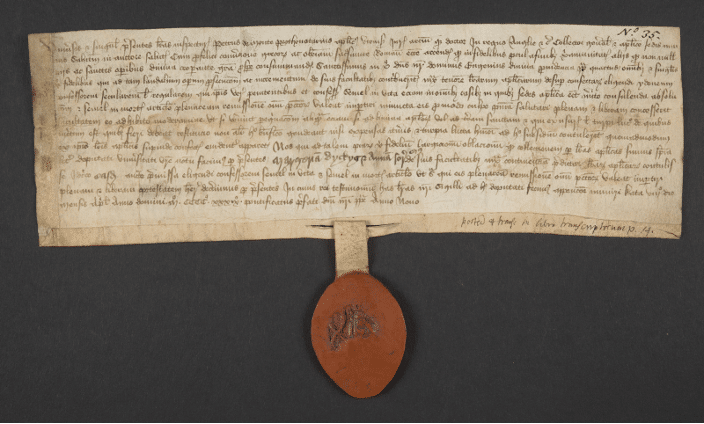
The above indulgence (Stowe Ch 607) was issued in the name of Pope Eugenius IV (r. 1431–1447) by Peter de Monte (c. 1400–1457), the controversial papal collector for England from 1435 to 1441.Stowe Ch 607 is an indulgence issued in 1439 to two sisters, Margery and Anna Dicks, which allowed them to choose their own confessor who could offer a full remission of sins. Although hand-written, this indulgence was mass produced, with blank spaces left for the names of whoever bought it. The text states that their money would go towards the conversion of the Greeks (that is, from Greek Orthodox to Roman Catholic Christianity) and the defense of Christendom’s frontiers. At the time of the Reformation, indulgence collectors were often accused of corruption by Protestants like Martin Luther, whose Ninety-Five Theses (1517) was written in response to the collector Johann Tetzel, but such men also came in for criticism in the 1400s.
We know little about Margery and Anna, not even the amount they paid for their indulgence (which would have been based on their wealth and status). A partial indulgence, that remitted only certain sins, could easily cost a skilled tradesman a week’s salary. The type purchased by Margery and Anna (known as a plenary indulgence) would have cost considerably more. We can only assume that they believed in its effectiveness of shortening the time they would spend in Purgatory. As this indulgence was issued in support of the Crusades, and in unifying the Latin and Greek churches, the sisters may have held an interest in supporting the defense and expansion of Latin Christendom, a cause that was widespread in late medieval England.
In 1444, Peter de Monte was to be investigated by the archbishop of Canterbury and two other churchmen, following rumors that he had received huge sums of money from these indulgences, but had sent only a small amount to the papal coffers. Later, Gascoigne named de Monte as one of the corrupt sellers of indulgences, calling him a ‘very arrogant Lombard’ (he was actually Venetian). Gascoigne alleged that some people had received indulgences from de Monte in return for ‘false carnal pleasure’, and he claimed that when de Monte lost a game of football, he would give the winner a sealed indulgence instead of money. Although Peter de Monte was investigated by the papacy, he seems to have escaped punishment for his corrupt activities. He was nominated bishop of Brescia, in northern Italy, in 1442, taking up his post in 1445. He withdrew from secular politics following the death of Eugenius IV in 1447, focusing on his bishopric until he died in 1457.

The Pardoner of Geoffrey Chaucer’s Canterbury Tales carried several fake relics, from a collection of pig bones to a pillowcase which he claimed was the Virgin Mary’s veil, selling them to gullible village priests. Dissidents like the Lollards and many church reformers also criticized indulgences and those who sold them. Thomas Gascoigne (1404–1458), who was chancellor of Oxford University in the 1440s, wrote that people could buy indulgences ‘for an offering of ale, and others for a loathsome act of sin; and others had baskets full of letters of indulgence to sell them throughout the country to whoever wanted to buy them.’
Information courtesy of: MacLellan, Rory. “A Pardoner’s Tale.” Medieval Manuscripts Blog, The British Library, 20 Oct. 2022,
Optional Activities
Working as a Pardoner: Corruption, Satire, and Morality in Chaucer’s England
Activity #1: Experiencing the Role of a Pardoner : Students will assume the roles of medieval pardoners and create their own indulgences, justifying their value. This role-playing activity will highlight the moral ambiguity of the system.
Instructions: Divide students into small groups. Each group receives a scenario (e.g., a noble seeking to buy indulgences to absolve war crimes, a peasant desperate for divine favor). Groups design their own indulgences, pricing them according to their perceived ‘value.’ Students present their indulgences to the class, explaining their justification. Class discussion: How does this exercise reflect the themes in ‘The Pardoner’s Tale’?
Activity #2: Analyzing the Pardoner’s Sales Pitch: Chaucer’s Pardoner is both a master storyteller and a manipulative salesman. In this activity, students analyze his rhetorical techniques and practice delivering persuasive speeches.
Instructions: Students break into pairs and read a passage from ‘The Pardoner’s Prologue. Identify rhetorical strategies: irony, direct address, appeals to fear and guilt. Each pair delivers the passage as a persuasive speech, adopting the tone of a real medieval pardoner. Class discussion on how the Pardoner manipulates his audience and how this connects to larger themes.
Activity #3: Greed and the Allegorical Landscape: In ‘The Pardoner’s Tale,’ setting plays a symbolic role. This activity compares the literal and allegorical significance of key locations in the tale.
Instructions: Students complete a graphic organizer comparing the literal vs. allegorical significance of the tavern, the road, and the tree. Group discussion: How does Chaucer use setting to reinforce his moral critique? Students write a short reflection: How does this setting compare to moral landscapes in other works they have studied?
Assessment
-Formative: Exit tickets, group discussions, annotated readings.
-Summative: A written essay analyzing the Pardoner’s hypocrisy and its broader implications in medieval and modern contexts.
Suggested Reading
Boitani, Piero, and Jill Mann, editors. The Cambridge Companion to Chaucer. Second edition., Cambridge University Press, 2003.
Brown, Peter. A Companion to Chaucer. 1st ed., John Wiley & Sons, Incorporated, 2001.
Burnley, J. D. A Guide to Chaucer’s Language. Macmillan, 1983.
Chaucer, Geoffrey, et al. The Riverside Chaucer. 3rd ed., Houghton Mifflin, 1987.
Johnson, Ian R., editor. Geoffrey Chaucer in Context. Cambridge University Press, 2019.
Mann, Jill. Chaucer and Medieval Estates Satire : The Literature of Social Classes and the General Prologue to the Canterbury Tales. Cambridge University Press, 1973.
Miller, Robert Parsons. Chaucer: Sources and Backgrounds. Oxford University Press, 1977.
Patterson, Lee. Chaucer and the Subject of History. University of Wisconsin Press, 1991.
Turner, Marion. Chaucer : A European Life. Princeton University Press, 2019.
—-. The Wife of Bath : A Biography. Princeton University Press, 2023.
Further Resources & Digital Humanities Projects
The Canterbury Tales Project. The Huntington Library, 2020-present http://www.canterburytalesproject.org/
Harvard Geoffrey Chaucer Website. Edited by Larry D. Benson, Harvard University, 2024 https://chaucer.fas.harvard.edu/
Robinson, Peter, and Elizabeth Solopova, editors. The Canterbury Tales: Fifteenth-Century
Texts – The Hengwrt Manuscript. TEAMS Middle English Texts Series, University of
Rochester, 2000 https://d.lib.rochester.edu/teams/publication/robinson-canterbury-tales-project
Whittle, S., Groves, M. and Pidd, M. 2024. The Pardoner’s Prologue and Tale: A Generative AI Edition for Teaching. Digital Humanities Institute. Available at https://www.dhi.ac.uk/ai-chaucer/
Pedagogy & Chaucer Resources
Bale, Anthony. “Reflections on Chaucer, Pedagogy, and the Profession of Medieval Studies.” New Chaucer Studies: Pedagogy and Profession, vol. 1, no. 1, Fall 2020, pp. 6–17. Bale reflects on methods of teaching Chaucer in both secondary and undergraduate contexts, emphasizing student-centered approaches and the adaptability of Chaucer’s texts for diverse classrooms.
Driver, Martha. “Teaching Chaucer in Middle English: A Fundamental Approach.” Approaches to Teaching Chaucer’s Canterbury Tales, edited by Peter W. Travis and Frank Grady, Modern Language Association of America, 2014, pp. 58–65. Driver advocates teaching Chaucer directly in Middle English, providing practical scaffolding strategies for vocabulary, pronunciation, and comprehension that work even at the high school level.
Mueller, Alex. “Surviving and Thriving in Secondary Schools: A Response to the Cluster on ‘Medieval Studies and Secondary Education.’” New Chaucer Studies: Pedagogy and Profession, vol. 4, no. 1, Spring 2023, pp. 97–108. This case-study–style essay examines real-world experiences of teaching medieval literature at the secondary level, offering candid reflections about challenges and successful strategies.
New Chaucer Studies: Pedagogy and Profession. Edited by Susanna Fein and Candace Barrington, New Chaucer Society, 2019–present. https://escholarship.org/uc/ncs_pedagogyandprofession
This peer-reviewed, open-access journal focuses specifically on Chaucer pedagogy and is an invaluable resource for innovative teaching strategies and case studies.
Raupp, Edward R. “Teaching the Big Three: Making Sense of Chaucer, Shakespeare, and Milton.” Journal of Education in the Black Sea Region, vol. 6, no. 2, 2021, pp. 65–76. https://share.google/CQnq10PRyJzdloTUj. Raupp provides strategies for teaching canonical authors in accessible ways, showing how to connect Chaucer’s themes—such as greed, hypocrisy, and morality in the Pardoner’s Tale—to contemporary student experiences.
Sprunger, David. “Introduction to Innovative Approaches to Teaching Chaucer.” Digital Commons @ Western Kentucky University, 2015. https://share.google/i8xhGU2zzfEq8Bw6x. Sprunger surveys experimental approaches to Chaucer pedagogy, highlighting multimedia, performance, and collaborative techniques, many of which translate well to the high school classroom.
“Talking about Chaucer with School Teachers.” The Cambridge Companion to The Canterbury Tales, edited by Piero Boitani and Jill Mann, 2nd ed., Cambridge UniversityPress, 2003, pp. 254–266. This essay addresses the challenges of introducing Chaucer to school audiences, with practical advice for making Middle English approachable and relevant to younger learners.