

Lesson plan
Living Like a Monk
Matthew Baker (History PhD ’24; University of Albany)
This lesson introduces the history of monasticism in medieval Europe, focusing on the daily life of monks within the monastery.

Student Learning Objectives
- Be introduced to the history of Christian monasticism from the third through the fifteenth centuries
- Experience daily life in the monastery through both immersive simulation and primary and secondary source analysis
- Begin thinking about how monastic traditions extend into the modern world, through both cultural legacy and ongoing efforts to preserve manuscripts
IMPORTANT TERMS
- Monasticism
- Monk
- Rule
- Asceticism
- Hermit
- Abbot
- Carolingian
- Patronage
- “Factory of prayer”
- Ora et labora
- Order
What is Monasticism?
Who are Monks?

When we talk about “monasticism” in the Middle Ages, we are giving a single name to what was really a whole galaxy of diverse ways of life that developed differently all around the Mediterranean Sea. Nevertheless, these many different “monasticisms” tended to have two things in common: 1) intentional withdrawal from the broader world and 2) strict religious regulation. Christian monasticism is often—but certainly not always—lived in community and under the guidance of a rule (see Activity #1). It can be performed by men or women, both of whom we can call monks, though Christian monastic women are often also called nuns.
The story of Christian monasticism begins in scattered houses and villages all around the Mediterranean, in the first few centuries CE. There, some Christian men and women began withdrawing from their communities, often secluding themselves within their own homes amongst their friends and families or pushing to the outskirts of town to separate from the hustle and bustle of daily affairs. These secluded Christians learned to tightly manage their minds and bodies through practices of asceticism, the act of paying very close attention to habits of eating, sleeping, prayer, reading, leisure etc. and regulating these habits in an effort to bring themselves nearer to God.
Our best evidence for very early forms of monasticism comes from around the year 300 CE and from the deserts of Egypt, just outside the Nile River Delta. Here and in these years, a small number of Christian men and women secluded themselves even further, leaving their jobs, their hobbies, their friends, and usually even their families behind them and moving to the deserts that sat just outside the city limits. The most famous stories about these early isolated monks (called hermits from the Greek word for “lonely” or “desert”) come from the Life of Saint Antony and collected Sayings of the Desert Elders, as well as several other primary accounts from the fourth and fifth centuries. These sources paint a picture of heroic hermits, men and women standing all night in the desert cold, refusing to speak for decades on end, or sometimes even fighting off demons with their bare fists (and usually getting themselves beaten up in the process!). Their stories were hugely popular all over the Mediterranean throughout the next century, from Constantinople and Syria in the east all the way to modern-day France and Spain in the west, and they inspired many others to follow their lead. One famous example of these stories’ influence comes from around the year 386 CE. A young man named Augustine (future bishop, scholar, and saint) welcomes a visitor to his home in Milan who tells him about the Egyptian hermit Antony and the book of his Life. Augustine is so shaken by the story, by the wild man fighting demons in the desert, that he breaks down in tears and cries out to his friend, “What is the matter with us? What is the meaning of this story? These men [i.e., people like Antony] have not had our schooling, yet they stand up and storm the gates of heaven while we, for all our learning, lie here groveling in this world of flesh and blood!” Antony had left Augustine awestruck. And he was not alone. Antony’s Life would become something like an ancient “best-seller” and was the most important model for Christian monks and hermits for centuries afterward.
Around this same time, some monks, both in Egypt and elsewhere, instead of practicing their monasticism alone like the hermits, opted to live together in organized communities called monasteries. Some of these monasteries developed a hierarchy, arranging the common monks under a group of seniores (“elders”), including, most of all, the abbot (see Activity #3). Abbots sat at the head of the monastic community and often had complete authority in their monasteries, controlling and patrolling all parts of the monks’ daily lives. By the eighth century, these monasteries also tended to operate under a “rule,” the name medieval authors gave to the community’s written guidelines (see Activity #1). Some of the more complex rules outlined every detail of the monastic day, including the regular Psalm readings and the roughly eight daily “hours” of prayer set aside for prayer. This collective kind of monasticism, lived in a monastery and under both a rule and an abbot, would become the definitive expression of monasticism only after the Carolingian reforms of the ninth century, which attempted to standardize the wide variety of rules and monastic living arrangements that had cropped up over the four centuries prior (see Activity #2).
“Why would someone want to leave the world and join a monastery in the first place?” you may be asking. Medieval people must have asked this question, too. Practically speaking, monasteries could offer people safety and seclusion. They could nurse the sick, feed the hungry, and get the poor back on their feet. They might also become the happy recipients of noble patronage, money from royals and aristocrats meant to support the monastery’s efforts and gain their favor, which could in turn lend the monastery some serious cultural and political power. In a well-supported monastery, a monk could expect to learn to tend all sorts of crops and livestock, or perhaps to make cheese and wine (see Activity #2). They might learn the skilled work of a craftsman, or they might operate and manage the local gristmill, housed inside the monastery’s walls. And, crucially, nearly all the monks would learn to read Latin—a skill most people in the Middle Ages never had the chance to acquire. But medieval people seem to have been drawn most of all to the monastery as a means of pursuing their own salvation (see Activities #1 and #4) and, what’s more, the salvation of their king and country. They, like Augustine, wanted to “storm the gates of heaven” through their prayer and monastic devotion. The medieval monastery became something like a “factory of prayer” where the community performed the crucial role of praying on behalf of their ruler and, if they prayed with enough sustained effort and focus, absolving her or him of their many sins. This prayerful affiliation with the crown became a model by which some monasteries (like St. Gall and Cluny, in Activities #3 and #4) accrued lasting political prestige in the Middle Ages. In short, the Benedictine monastery was grounded in the principal of ora et labora (“pray and work”).
Though monasteries still operate today all over the world, they no longer enjoy the same cultural importance they once did in the Middle Ages (see Activity #5). Surveys released by the Catholic Church in Rome have counted fewer than 16,000 members of the monastic orders in the year 2022, and the average age of those monks is somewhere north of sixty. Monasticism, as people of the Middle Ages came to know it, has faded into the cultural backdrop. Nevertheless, some elements of the medieval monastic world still survive in our cultural memory. Medieval monks are perhaps best remembered today for their work in preserving knowledge by copying manuscripts. If we picture the medieval monk at all, we tend to imagine him bent over a text, engaged in the silent work of transferring a passage of Latin from one old parchment to another. And as we will see (Activity #5), something like this remains an important function for monasticism even in the twenty-first century.

ACTIVITIES
The Rule of Benedict was written in the first half of the sixth century. It has traditionally been attributed to Benedict of Nursia, the abbot of Montecasino, a monastery situated atop a steep hill some 80 miles outside Rome. Within Christian monasticism, a “rule” like Benedict’s establishes the goals of the monastery. It outlines the monastery’s vision and purpose. A rule can also act as a sort of instruction manual that orders a monk’s daily life. It determines when a monk wakes up, when they go to bed, when and how they eat, read, work, and pray. Rules often also establish rank and hierarchy in the monastery. Who is in charge? What authority do they have? And what happens when junior monks misbehave?
Although The Rule of Benedict was not the first monastic rule of this kind, it would eventually become the most widely used rule in the Latin-speaking medieval world. By the year 1000, monasteries all over Europe used some form of Benedict’s Rule.
Because of the specific instructions it includes for monastic living, the Rule of Benedict lets us take a peek inside the medieval monasteries of Western Europe (or at least into the idealized version Benedict envisioned) to see what it meant to live like a monk.
READ:
Directions: Read the following descriptions from the Rule of Benedict (c. early sixth century) and answer the questions.
Prologue (Click to open)
Listen, my son, to your master’s precepts, and incline the ear of your heart. Receive willingly and carry out effectively your loving father’s advice, that by the labor of obedience you may return to Him from whom you had departed by the sloth of disobedience.
To you, therefore, my words are now addressed, whoever you may be, who are renouncing your own will to do battle under the Lord Christ, the true King, and are taking up the strong, bright weapons of obedience. . .
And so, we are going to establish a school for the service of the Lord. In founding it we hope to introduce nothing harsh or burdensome. But if a certain strictness results from the dictates of equity for the amendment of vices or the preservation of charity, do not be at once dismayed and fly from the way of salvation, whose entrance cannot but be narrow. For as we advance in the religious life and in faith, our hearts expand, and we run the way of God’s commandments with unspeakable sweetness of love. Thus, never departing from His school, but persevering in the monastery according to His teaching until death, we may by patience share in the sufferings of Christ and deserve to have a share also in His kingdom.
- What words does the author of the Rule of Benedict uses to describe the monastery?
Chapter 58: On the Manner of Receiving Brothers and Sisters (Click to open)
When anyone is newly come for the reformation of his life, let him not be granted an easy entrance; but, as the Apostle says, “Test the spirits to see whether they are from God.” If the newcomer, therefore, perseveres in his knocking, and if it is seen after four or five days that he bears patiently the harsh treatment offered him and the difficulty of admission, and that he persists in his petition, then let entrance be granted him, and let him stay in the guest house for a few days.
After that let him live in the novitiate, where the novices study, eat and sleep. A senior shall be assigned to them who is skilled in winning souls, to watch over them with the utmost care. Let him examine whether the novice is truly seeking God, and whether he is zealous for the Work of God, for obedience and for humiliations. Let the novice be told all the hard and rugged ways by which the journey to God is made.
If he promises stability and perseverance, then at the end of two months let this Rule be read through to him, and let him be addressed thus: “Here is the law under which you wish to fight. If you can observe it, enter; if you cannot, you are free to depart.” If he still stands firm, let him be taken to the above-mentioned novitiate and again tested in all patience. And after the lapse of six months let the Rule be read to him, that he may know on what he is entering. And if he still remains firm, after four months let the same Rule be read to him again.
Then, having deliberated with himself, if he promises to keep it in its entirety and to observe everything that is commanded him, let him be received into the community. But let him understand that, according to the law of the Rule, from that day forward he may not leave the monastery nor withdraw his neck from under the yoke of the Rule which he was free to refuse or to accept during that prolonged deliberation.
- How long would it take a prospective monk to join Benedict’s monastery?
- Why do you think the author of the Rule of Benedict is so concerned with testing newcomers?
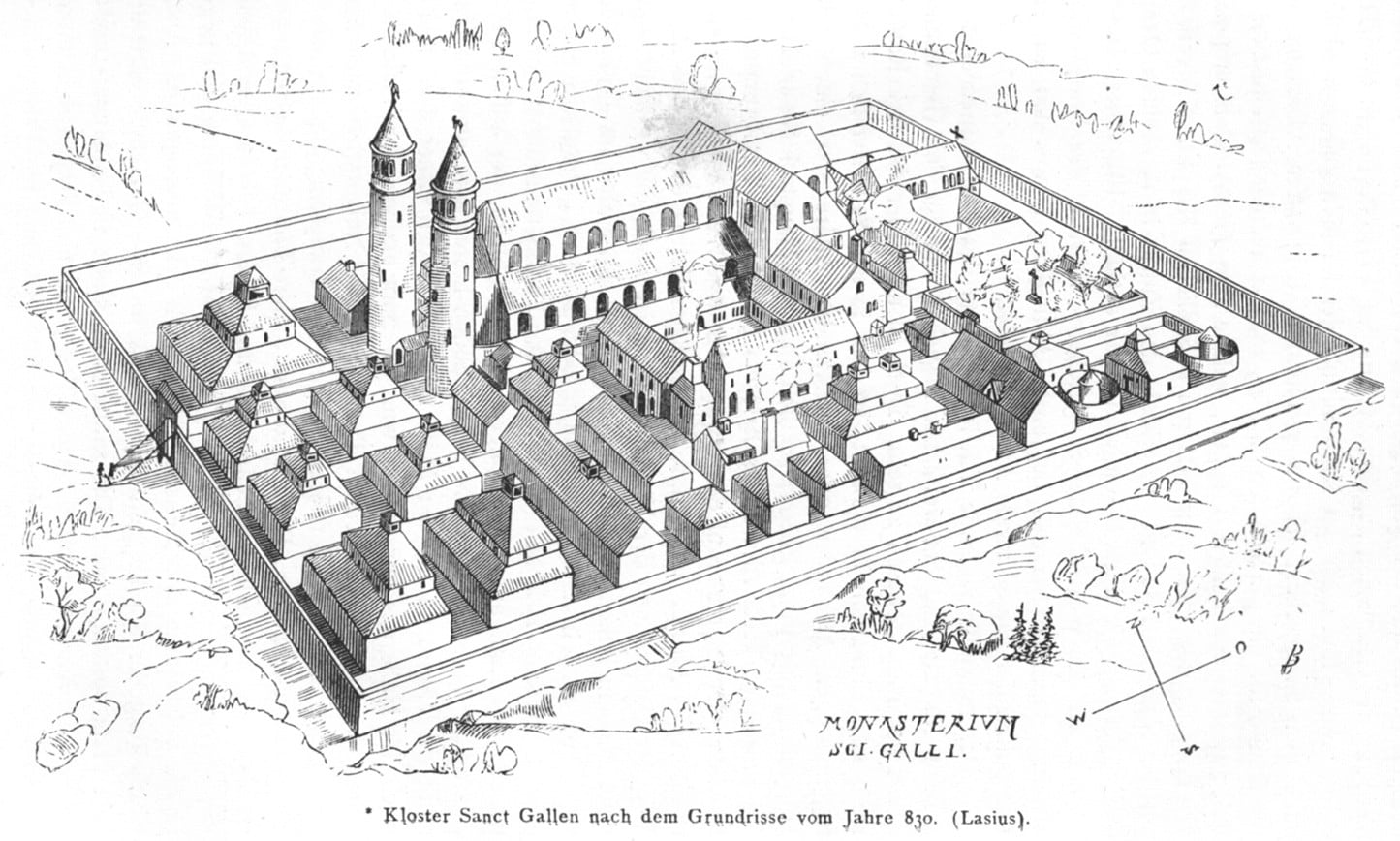
The Plan of Saint Gall
Though it was never actually built, the Plan of Saint Gall offers another window onto life inside a medieval Benedictine monastery. The magnificently detailed Plan, drawn around the year 820 CE and stored away in the monastery of Saint Gall (in modern Switzerland), is one of the only architectural “blueprints” to survive from the early Middle Ages. It presents an idealized picture of a place putting the Rule of Benedict into practice—just the kind of arrangement the Carolingian reforms endorsed—complete with a school, garden, library, farm, and even a brewhouse.
Virtual Plan of Saint Gall Virtual tour created in Minecraft by a student


Despite the Carolingians best efforts to regulate and standardize monastic practice in the ninth century, diversity and innovation remained important features of medieval monasticism. The Abbey at Cluny in what is today eastern France (whose sign language we borrowed in Activity #3), for example, initiated major reforms in the tenth century that promoted a stricter observance of the Rule of Benedict. Monks at Cluny practiced new and more complex forms of liturgy, or public worship, at the church altar. Even more than other Benedictines, they kept silent at nearly all times. And perhaps most importantly, they answered directly to the pope in Rome rather than the local dukes and aristocrats.
Other reformers in the period founded entirely new orders, networks of monasteries professing different vows and adhering to different practices. The monks of Byland Abbey, in Yorkshire, in the far north of England, were part of one of these innovative orders. The monks of Byland belonged to a group called the Cistercians, who followed the Rule of Benedict like nearly all medieval monks, but focused more than other Benedictines on simplicity, agriculture, and the values of manual labor.
By the end of the twelfth century, Byland Abbey had become the largest Cistercian church in England, thanks mostly to the patronage provided by aristocratic benefactors in exchange for the monks’ prayers. This patronage connection made Byland one of medieval England’s foremost “factories of prayer.”
However, Byland is not only remembered for its connection to royals and aristocrats. Sometime around the year 1400, the monks of Byland produced a famous collection of texts recalling some unsettling encounters with ghosts, revenants, and the undead. These twelve stories all take place in and around the monastery grounds of Byland and feature the monks and some local notables as central characters.
As you read them, imagine the monks gathered in their dimly lit chapter house listening to their abbot read from the collection. Consider what you might be feeling or thinking as you sat alongside them and heard about the ghosts that haunted the grounds.
Chapter III.
Concerning the ghost of Robert the son of Robert de Boltby of Kilburn, which was caught in a churchyard.
I must tell you that this Robert the younger died and was buried in a churchyard, but he had the habit of leaving his grave by night and disturbing and frightening the villagers, and the dogs of the village used to follow him and bark loudly. Then some young men of the village talked together and determined to catch him if they possibly could, and they came together to the cemetery. But when they saw the ghosts they all fled with the exception of two. Of these, one, called Robert Foxton, seized him at the entrance to the cemetery and placed him on the kirkstile while the other cried manfully, “Keep him fast until I come to you.”
The first one answered, “Go quickly to the parish priest that the ghost may be conjured, for with God’s help I will hold firmly what I have got until the arrival of the priest.”
The parish priest made all haste to come and conjured him in the name of the Holy Trinity and in the virtue of Jesus Christ that he should give him an answer to his questions. And when he had been conjured, he spoke in the inside of his bowels, and not with his tongue, but, as it were, in an empty cask, and he confessed his different offences. And when these were made known the priest absolved him but charged those who had seized him not to reveal his confession in any way; and henceforth as God willed, he rested in peace.
It is said, moreover, that before his absolution he would stand at the doors of houses and at windows and walls, as it were, listening. Perhaps he was waiting to see if anyone would come out and conjure him and give help to him in his necessity. Some people say that he had been assisting and consenting to the murder of a certain man, and that he had done other evil things of which I must not speak in detail at present.
Chapter IV.
Moreover the old men tell us that a certain man called James Tankerlay, formerly Rector of Kirby, was buried in front of the chapter house at Byland, and used to walk at night as far as Kirby; and one night he blew out the eye of his concubine there. And it is said that the abbot and convent caused his body to be dug up from the tomb along with the coffin, and they compelled Roger Wayneman to carry it as far as Gormyre. And while he was throwing the coffin into the water, the oxen were almost drowned for fear. God forbid that I be in any danger for, even as I have heard from my elders, so have I written. May the Almighty have mercy upon him if indeed he were of the number of those destined to salvation.
Chapter VI.
Concerning a certain canon of Newburgh who was seized after his death by [blank].
It happened that this man was talking with the master of the ploughmen and was walking with him in the field. And suddenly the master fled in great terror and the other man was left struggling with a ghost who foully tore his garments. And at last, he gained the victory and conjured him. And he, being conjured, confessed that he had been a certain cannon of Newburgh, and that he had been excommunicated for certain silver spoons which he had hidden in a certain place. He therefore begged the living man that he would go to the place he mentioned and take them away and carry them to the prior and ask for absolution. And he did so, and he found the silver spoons in the place mentioned. And after absolution, the ghost henceforth rested in peace. But the man was ill and languished for many days, and he affirmed that the ghost appeared to him in the habit of a canon.
Questions:
- Who might have been the audience for monastic ghost stories? Why?
- What can we assume about the social background of James Tankerlay, the undead man from story IV? What clues does the source give us?
- Why might the monks of Byland want to read, collect, and preserve stories like this?
- How do these ghost stories compare to other ghost stories you have heard or read about? What similarities and differences do you notice in the way both the living and the supernatural dead behave?